A chess variant
Two 8×8 faces wrap into one closed world. Every piece you know still moves the way you know — but the edge of the board, the thing every chess habit is built on, simply isn’t there any more.
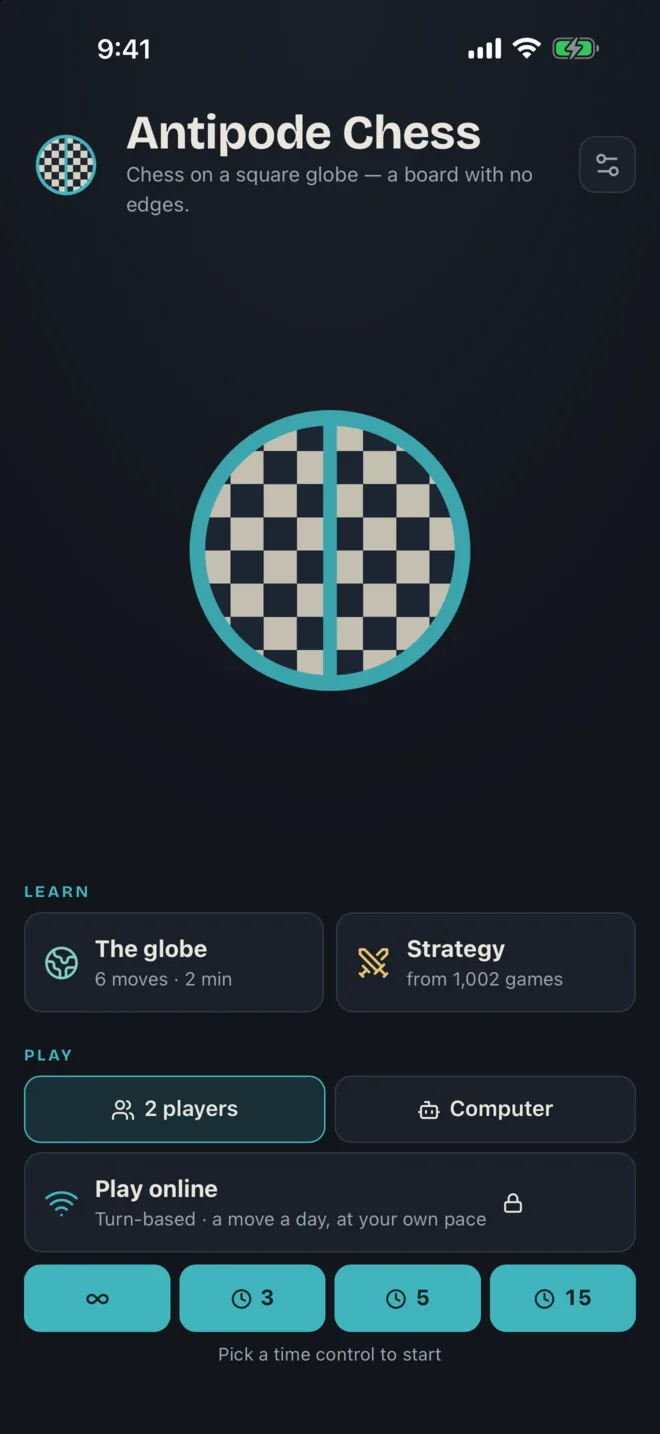
The board
You see two 8×8 boards on screen. They are not two boards — they are the two faces of a single closed surface, 128 squares with nowhere to fall off.
Not by two different pieces. By the same rook, along the same rank, arriving from opposite directions. That is the antipode, and it is where the game gets its name.
What changes
Everything you know about the edge of the board does not. Six rules behave differently — and every one of them is a consequence of the same thing: the surface is closed.
Over the pole, and the long way around the world — the same rook, the same square, two routes at once. Blocking one does nothing about the other.
A light-squared bishop is light-squared everywhere on the globe, pole crossings included. The old rule survives the new geometry intact — which is exactly why it is worth checking.
There is no “up the board” on a globe. A pawn steps one square in any orthogonal direction and captures diagonally in any direction — so a pawn chain can face you from behind.
A pawn promotes at the point directly opposite its own starting square, through the centre of the world. Every pawn has its own goal, and every goal is as far from home as a square can be.
Cross a pole exactly at a face corner and both of your directions reverse at once. It is the one move that still surprises us, and the tutorial makes you do it on purpose.
Checkmate wins. Stalemate draws. No castling, no en passant. The pieces are the pieces — you are learning a board, not a new rulebook.
Learn it in two minutes
No wall of text. “Learn the globe” hands you a board and walks you through the six things that are different — one move at a time, each one drawing the route the piece actually took.
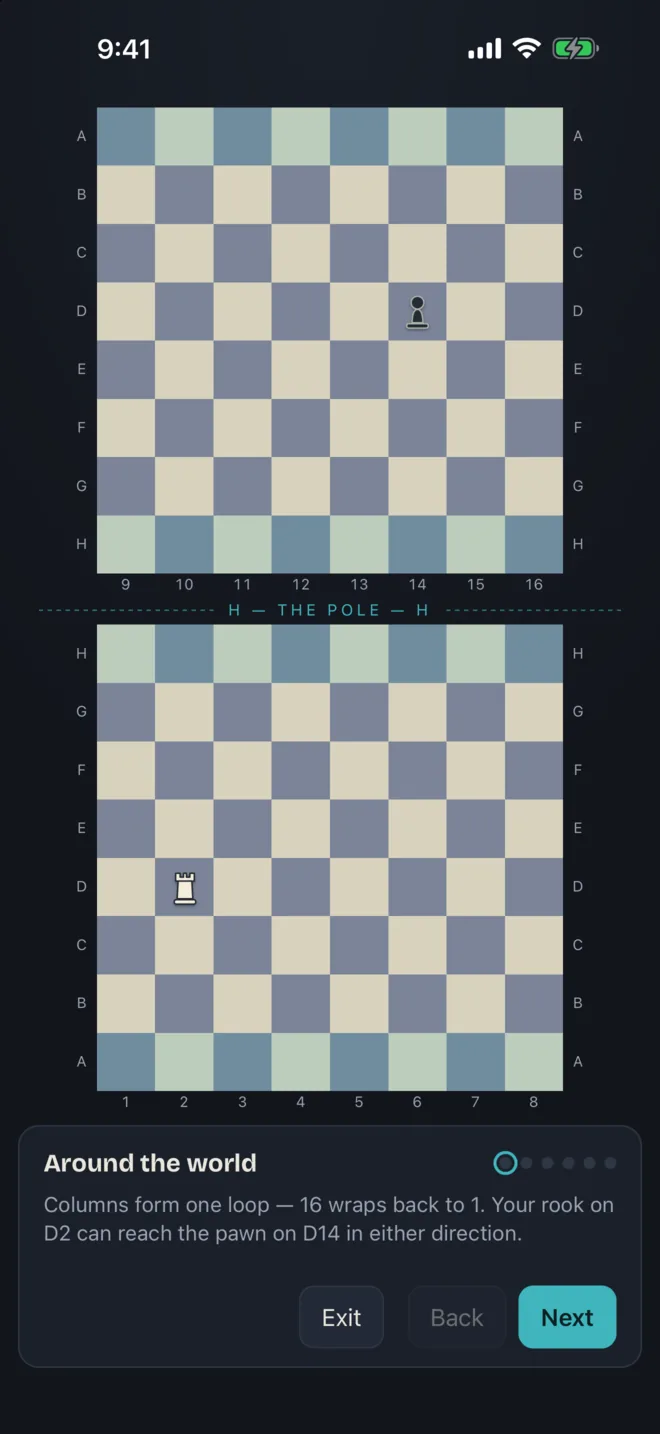
Learn the globeThe loop, the pole crossing, omnidirectional pawns, the colour-bound bishop, the corner bounce, and the two-front attack — six moves, about two minutes.
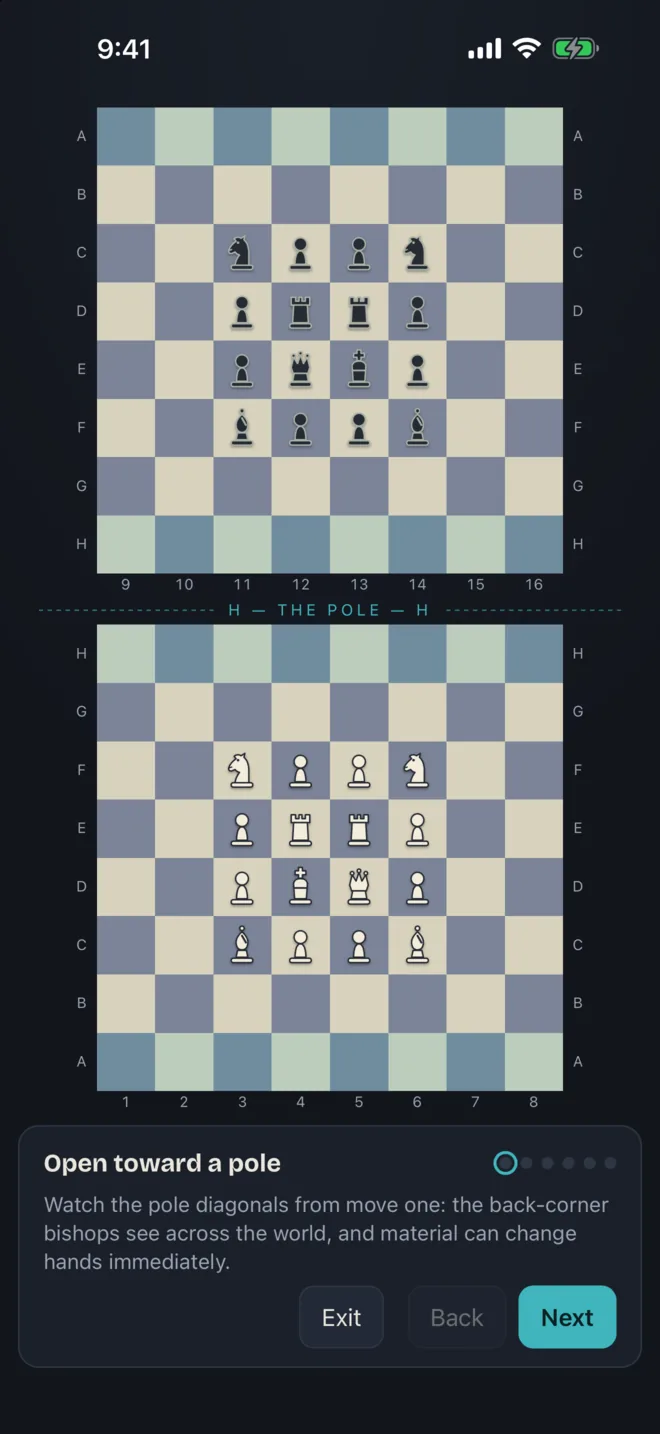
Winning strategiesWhat a thousand-plus engine games actually taught us — which openings hold up, where material changes hands early, and why the pole diagonals matter from move one.
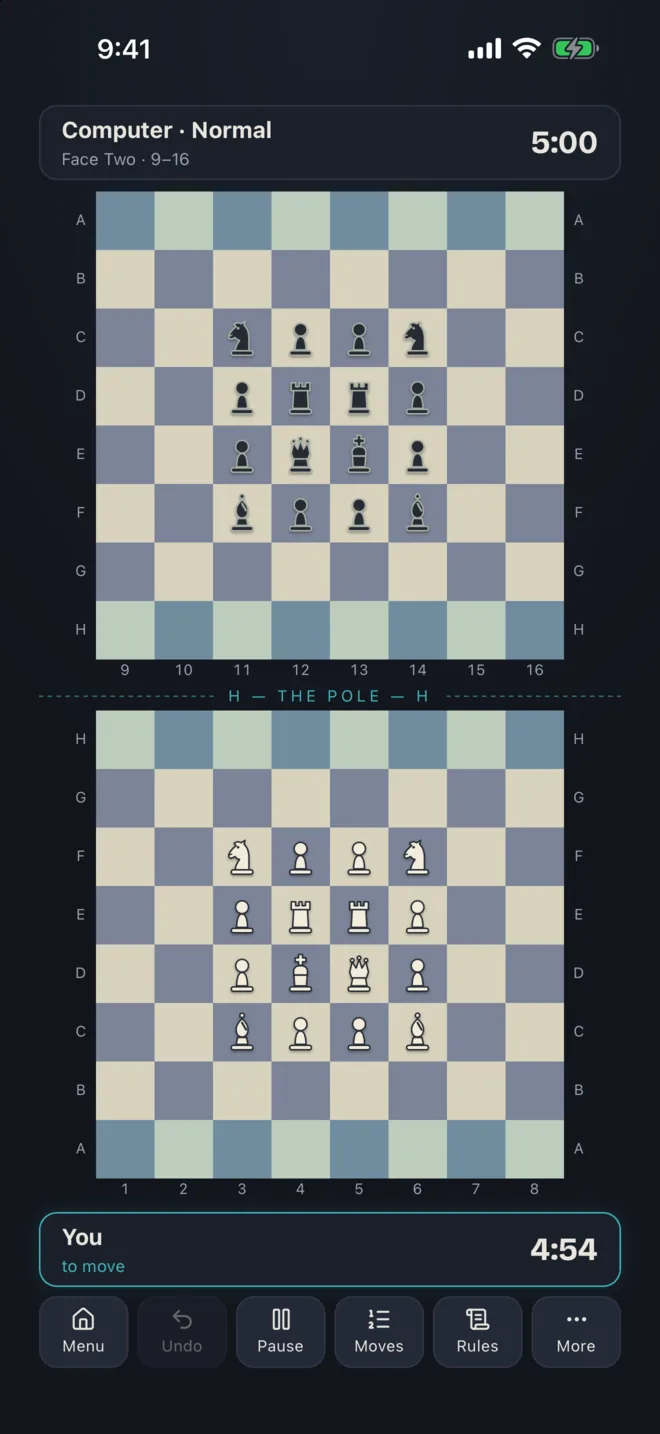
And a rules reference you can open mid-gameStuck on why a move is legal? The rules are one tap away without leaving the board — along with the full move history and undo.
Ways to play
Antipode Chess is built for the two ways people actually play chess: with someone sitting opposite you, and with someone you may never meet.
iPhone & iPad · iOS 16 or later
On the bigger screen
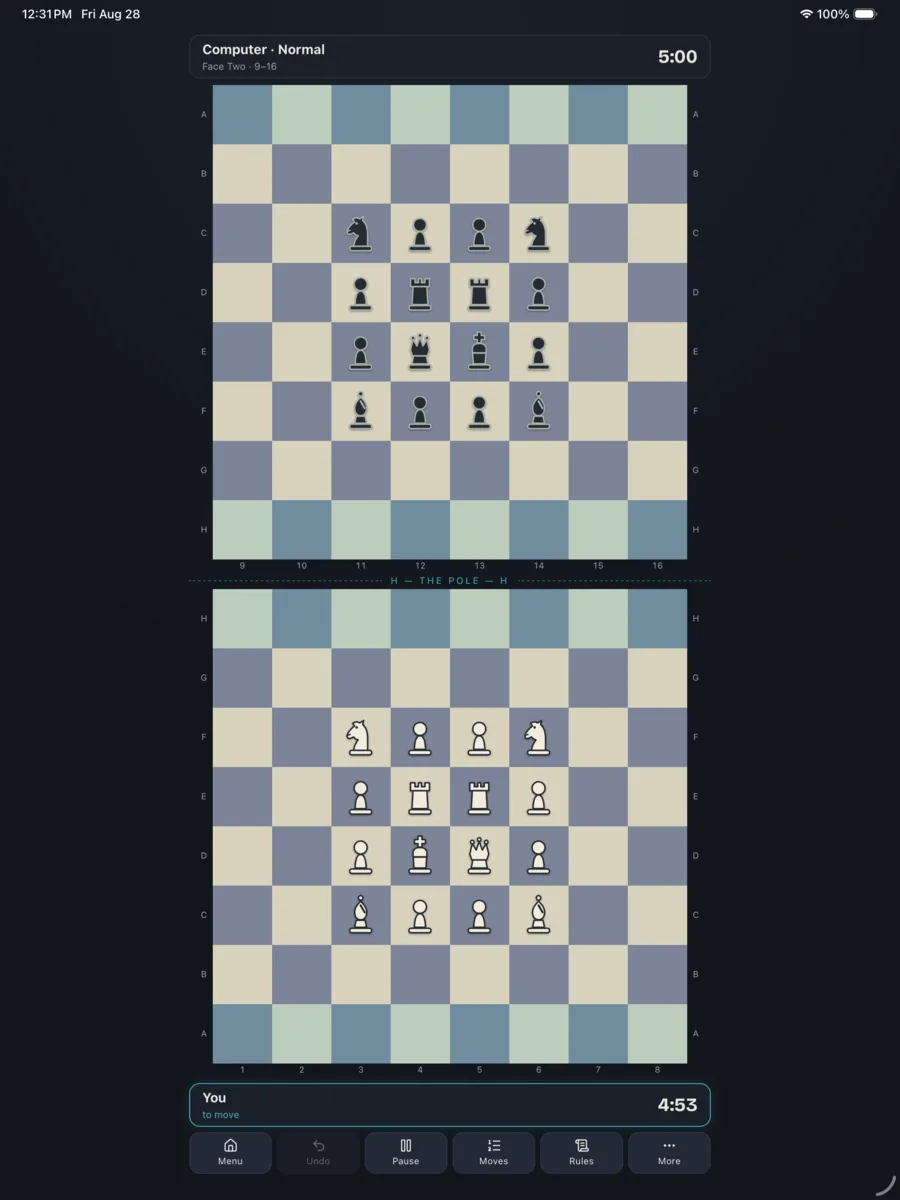
On iPad the whole world fits comfortably at once — which turns out to matter, because reading a two-front attack means reading both faces at the same time. Same game, same save, same purchase.
What it costs
Antipode Chess is free to download. There is exactly one optional purchase, it is a single payment, and we would rather tell you plainly what is on each side of that line than have you find out later.
No account, no trial, no timer.
A single purchase. No subscription.
Bought once, restorable on your other devices through the App Store. There is no second purchase, no currency, no energy meter and nothing else to buy.
Fair by design
We built this one for ourselves first, and the thing we wanted was a board and an opponent — not an account, a daily streak or a shop.
Not between games, not before a hint, not anywhere. One optional purchase and that is the whole business model.
No sign-up, no email, no password. Online play uses the Game Center account already on your device, and only if you choose to play online.
No analytics, no tracking, no advertising identifiers, no third-party SDKs. Your games and settings live on your device. Read the policy.
Easy, Normal and Hard all think locally. Everything except online play works with no connection at all.
No violence, no chat, nothing objectionable. If a seven-year-old can learn the loop — and ours did — they can play the whole game.
Play every mode, never touch a rating, and nothing nags you about it. Competition is a feature here, not the point.
Coming soon
Antipode Chess is on its way to iPhone & iPad. Leave an email and we’ll send exactly one message, the day it lands.
Made slowly, by a family, in the same house as the dragons.